
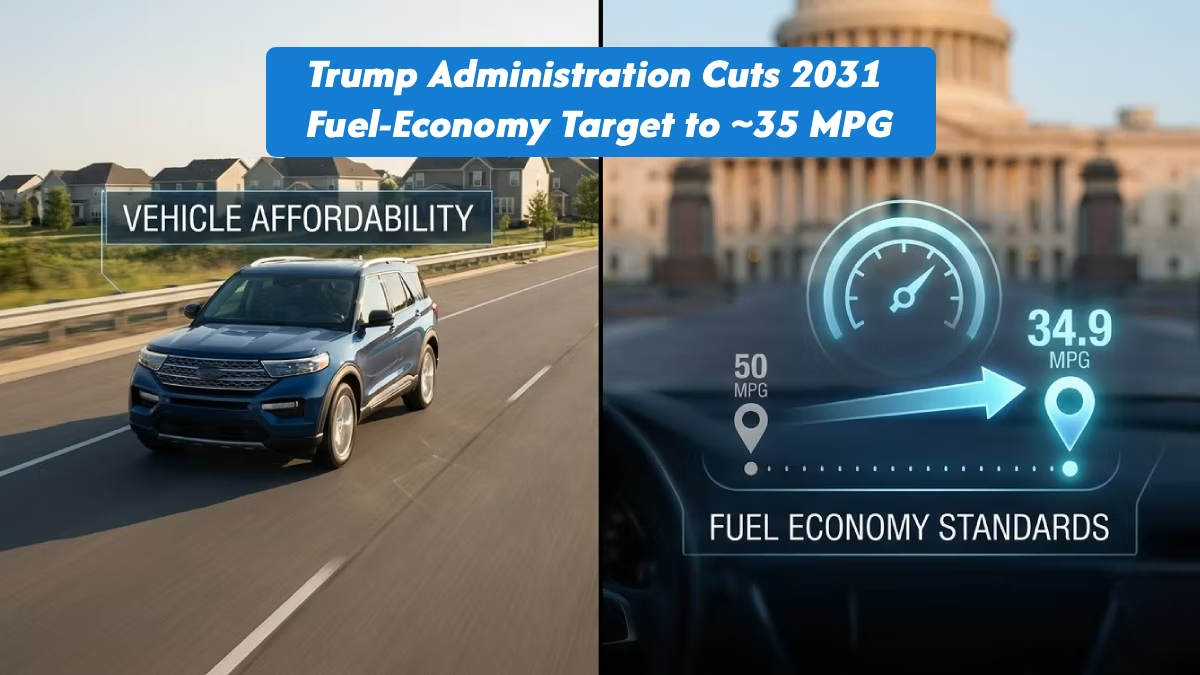
The Trump administration on Monday finalized new corporate average fuel economy standards that lower the 2031 fleetwide target to roughly 34.9 miles per gallon for passenger cars and light trucks, down from the 50.4 mpg projected under rules set during the Biden administration.
The Department of Transportation and the National Highway Traffic Safety Administration said the new standards will reduce the average cost of a new vehicle by $1,300 and save American families $138 billion over the next five years.
The rule, dubbed the ‘Freedom Means Affordable Cars’ initiative, resets CAFE standards for model years 2022 through 2031. Under the new schedule, the average is required to be 32.3 mpg in the 2027 model year and rise to 34.9 mpg fleetwide by 2031.
Transportation Secretary Sean Duffy said the previous standards functioned as a backdoor electric vehicle mandate. ‘Thanks to President Trump’s leadership, we have finally ended the illegal mandate that forced automakers to produce more expensive electric vehicles that American families didn’t want,’ Duffy said in a statement.
NHTSA Administrator Jonathan Morrison said the rule ‘restores integrity to the national fuel economy program, balancing vehicle affordability and energy conservation goals while improving safety on our roadways.’
Industry Response
The Alliance for Automotive Innovation, which represents major automakers including General Motors, Ford, and Stellantis, endorsed the final rule. ‘NHTSA made the right call to better align fuel economy standards with the law and current market conditions,’ said John Bozzella, the group’s president and CEO. ‘The standards finalized under the previous administration effectively required a switchover to electric vehicles that was out of step with market realities and customer demand. Today’s final rule is an appropriate course correction.’
Ford said it appreciated the administration’s work to align regulations with market realities. ‘As we evaluate the final rule’s full impact on our business, we’ll continue working with the Administration to build a strong American auto industry,’ a Ford spokesperson said.
General Motors and Stellantis did not immediately respond to requests for comment.
Environmental and Consumer Pushback
Environmental groups criticized the rollback and said they would challenge it in court. Dan Becker, director of the Center for Biological Diversity’s Safe Climate Transport Campaign, said the rule ‘ignores the feasibility of clean technology and the millions of fuel-efficient cars already on the road.’
‘Trump is tanking sensible mile per gallon standards at the worst possible time for consumers, who’re getting hit with sky-high prices at the pump,’ Becker said. ‘Consumers will pay the price for these reckless rollbacks while Trump’s Big Oil and Big Auto buddies reap the short-term profits.’
Becker told AFP his organization would be suing over the rule. ‘I describe it as a Trojan SUV that will lead to the demise of the American auto makers because they don’t have to compete against the best technology in the world,’ he said.
Katherine García, director of the Sierra Club’s Clean Transportation for All campaign, said the loosening of fuel standards would ‘make driving more expensive too.’ ‘Less fuel-efficient cars mean more gas burned, spending more at the pump, and dirtier air in our communities,’ García said.
Credit Trading and Vehicle Classification Changes
The final rule also eliminates the CAFE credit trading program beginning with the 2028 model year. The system allowed automakers to buy and sell credits earned when their fleets exceeded fuel economy targets. NHTSA said the program ‘artificially propped up the EV industry at the expense of traditional automakers’ and that its elimination ‘restores fairness, puts all automakers on an even playing field, and ensures that manufacturers are spreading fuel-saving technologies throughout their fleets.’
The change is expected to affect electric vehicle manufacturers such as Tesla, which has generated billions of dollars in revenue from selling regulatory credits to other automakers.
The rule also changes how vehicles are classified for fuel economy purposes beginning with the 2030 model year. Automakers have been able to classify some SUVs as light trucks, which face less stringent standards. The Department of Transportation estimates the classification mix will flip from roughly 70 percent light trucks and 30 percent passenger cars to about 70 percent passenger cars and 30 percent light trucks.
Most automakers lobbied against both the credit trading elimination and the reclassification changes. General Motors wrote in a public comment that NHTSA ‘underestimated the extent of this vehicle shift and the potential market distortions.’
Market Context
The rule was released as gasoline prices remain elevated. The national average for a gallon of gas was $4.47 on Sunday, up from $4.09 a month earlier, according to AAA. In Michigan, the average reached $4.67 on Monday morning.
The average price of a new vehicle was about $52,750 as of Monday, up roughly $2,750 from a year earlier, according to data cited by the Detroit News.
Trump wrote on Truth Social over the weekend that the new standards would ‘take the waste out of building cars in America’ and save families ‘thousands on a new, beautiful and safe car.’
The rule follows other deregulatory actions affecting the auto industry since Trump returned to office in January 2025. Congress previously removed penalties for automakers that failed to meet CAFE standards, and the Environmental Protection Agency reversed the legal finding that justified regulating greenhouse gas emissions from vehicles.
Environmental groups filed a separate lawsuit in February 2026 challenging the EPA’s rescission of the endangerment finding, arguing it will cost drivers $6,000 over the lifetime of a vehicle.